Dead Links, Dusty Archives, and the Art That Lives Inside Them
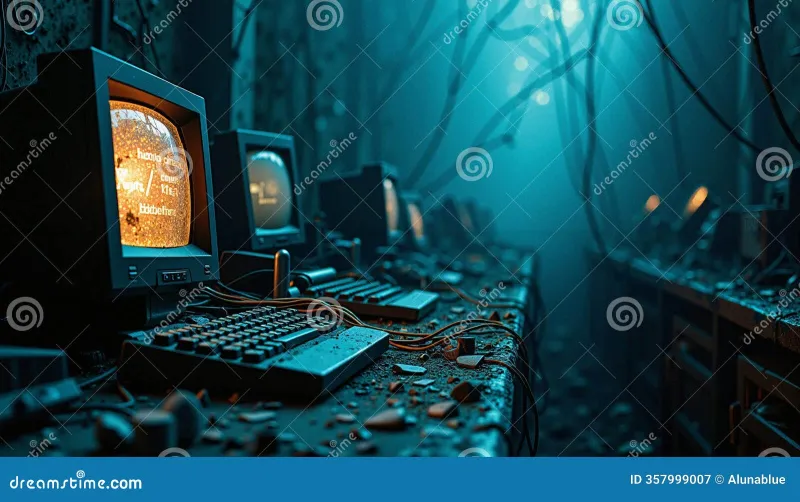
Photo: abandoned retro computer screen glitch aesthetic dark moody, via thumbs.dreamstime.com
Open a browser tab right now and type in a URL you haven't visited in ten years. Maybe it's a forum you used to post on in middle school. Maybe it's a Geocities mirror, or one of those early Tumblr blogs with the illegible neon-on-black color schemes and autoplay music. There's a decent chance you'll land on a 404 page, or something so visually broken it looks like a Dali painting rendered in HTML.
For a lot of people, that's a dead end. For a growing wave of Gen Z digital artists, it's a starting point.
The Ruins Are the Point
There's a word in Japanese — wabi-sabi — that describes the beauty found in impermanence and imperfection. It's been applied to cracked ceramics and weathered wood for centuries. But scroll through the work of artists posting to Behance, Are.na, or even the weirder corners of Instagram right now, and you'll see something that feels like a digital version of the same philosophy: a deliberate, almost reverent attention to the broken, the outdated, and the left-behind.
We're talking about artists who screenshot error messages and reframe them as minimalist posters. Designers who reconstruct the visual language of defunct social networks — MySpace layouts, early Facebook interfaces, the boxy navigation of pre-smartphone web design — and use them as templates for entirely new work. Photographers who composite their portraits against screencaps of dead websites, letting the pixel decay and broken image icons become part of the visual texture.
It's not just nostalgia, though nostalgia is definitely in the mix. It's something more pointed than that.
Polished to Death
Here's the thing about contemporary digital design: it's extraordinarily, suffocatingly clean. The dominant visual language of the 2020s internet — rounded corners, pastel gradients, sans-serif everything, that particular shade of off-white that every direct-to-consumer brand seems legally required to use — is technically flawless and almost completely devoid of personality.
Algorithmic pressure is a huge part of why. When your content is competing for attention across platforms that reward engagement metrics above all else, you optimize. You sand down the rough edges. You make things legible, shareable, instantly appealing. And somewhere in that process, a lot of the weirdness that made early internet culture so genuinely interesting got quietly smoothed away.
Abandoned digital spaces didn't go through that optimization cycle. A Tumblr blog from 2011 looks the way it looks because someone made choices for themselves, without a growth strategy or a content calendar. A defunct web forum has the visual fingerprints of whoever built it, quirks and all. That authenticity — chaotic, unmonetized, completely indifferent to the algorithm — is exactly what makes these spaces so compelling to artists who came of age in a world where everything online feels like it was designed by committee.
What the Archives Actually Hold
Tumblr's golden-age archives (roughly 2011–2014, before the platform's infamous content policy implosion) have become something close to sacred text for a certain strain of digital artist. The visual culture that emerged there — heavily edited photography, fanart, text posts that functioned as micro-essays, GIF sets as a genuine art form — was genuinely inventive in ways that didn't get recognized until it was already disappearing.
Artists like LA-based designer Mara Soleil have built entire visual identities around reconstructing that era's aesthetics: the heavy contrast edits, the Helvetica-on-photography compositions, the particular emotional register of a certain kind of sad-beautiful image paired with a cryptic caption. It's archaeology as much as it's design work.
Beyond Tumblr, there's a whole ecosystem of inspiration in places most people have forgotten existed. Abandoned Flash game portals. Early web art projects that only run on browsers that no longer exist. Defunkt social networks like Friendster and Vine (yes, people are still grieving Vine). The visual language of these platforms — clunky, earnest, often kind of ugly — carries a specific emotional weight that polished contemporary design simply can't replicate.
The Internet Archive as Art Supply Store
The Wayback Machine, the Internet Archive's tool for capturing historical website snapshots, has quietly become one of the most-used research tools among a certain kind of digital artist. Being able to scroll through a 2003 version of a website — to see how it actually looked, not how you remember it — provides a kind of visual raw material that's genuinely hard to find anywhere else.
Some artists are using these archives to create work that's explicitly about digital memory and impermanence: pieces that ask what it means that our collective online history is both more documented than any previous era's and more fragile, dependent on servers staying online, companies not going bankrupt, formats not becoming obsolete.
Others are less interested in the philosophical angle and more interested in the purely visual stuff — the specific colors, the specific fonts, the specific way information was organized on a page before UX design became a discipline. They're treating the archive as a texture library, a mood board, a place to find visual references that feel genuinely different from anything being made right now.
Authenticity You Can't Manufacture
There's an irony sitting at the center of all of this, and it's worth naming: the appeal of abandoned digital spaces is, in large part, their authenticity — the sense that nobody was performing for an audience when they built them. But the moment you start deliberately recreating that aesthetic, you've introduced exactly the kind of intentionality that made polished mainstream design feel hollow in the first place.
The artists doing this most interestingly seem aware of the tension. The best work in this space doesn't try to pretend it's actually from 2008 — it uses the visual language of that era to say something about now, about what we've lost and what we've traded away in the pursuit of optimization. The broken interface becomes a metaphor. The dead link becomes a meditation on impermanence.
That's the move that elevates this from nostalgia trip to genuine artistic practice: taking the ruins and building something new inside them.
The internet keeps accelerating forward, churning out new platforms and new aesthetic trends at a pace that makes your head spin. But somewhere in the background, in the spaces that didn't survive the churn, there's a whole visual history that's still waiting to be excavated. Gen Z artists are starting to dig — and what they're pulling up is worth paying attention to.