Bury It Where Everyone Can See It: The Rising Culture of Celebrating Creative Wreckage
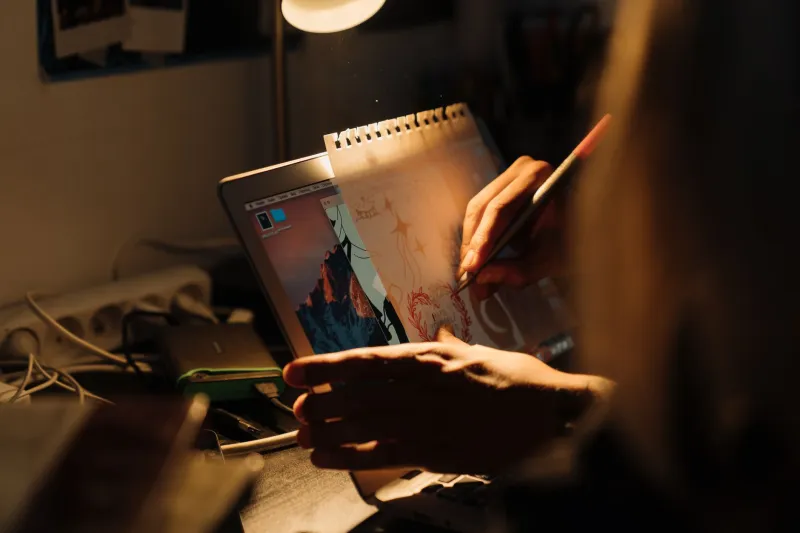
There's a folder on most digital artists' hard drives that never gets talked about in interviews. It doesn't show up in portfolio decks or Instagram grids. It's the one stuffed with half-rendered concepts, color palettes that went nowhere, rejected client work, and ideas that felt genius at 2 a.m. and embarrassing by noon. For a long time, that folder was basically a shame drawer. Now? Some of the most interesting creators online are treating it like a main event.
The shift is subtle but unmistakable. Across Behance, Substack, TikTok, and niche Discord communities, a wave of artists is not just acknowledging their failures — they're archiving them, annotating them, and in some cases building entire creative identities around them. The failed experiment isn't getting quietly buried anymore. It's getting a headstone, a spotlight, and a caption.
The Old Mythology of the Polished Portfolio
For decades, the dominant creative culture in the US operated on a pretty simple premise: show your best work, hide everything else. Art schools taught it. Design agencies enforced it. Portfolio sites were built around it. The implicit message was that professional credibility lived in the finished, the polished, the delivered.
That mythology made a certain kind of sense when the gatekeepers were galleries, agencies, and editorial directors. You had one shot to impress someone who'd seen a thousand portfolios, so you curated hard. The rough drafts stayed in the drawer.
But the internet, and specifically the creator economy, broke that logic pretty thoroughly. When artists started building direct relationships with audiences — not clients, not curators, but actual communities of people who followed them as humans rather than just as producers of output — the calculus changed. Audiences started wanting to see behind the curtain. And a lot of artists found that what was behind the curtain was actually more interesting than what they'd been putting in the window.
What 'Failure' Actually Documents
Here's the thing about a failed project: it's not nothing. It's a record of a decision that got made, a direction that got chosen, an aesthetic instinct that fired at a particular moment. Even when the result is objectively bad — muddy color choices, clunky composition, a concept that didn't survive contact with execution — it's still a document of how a creative mind was working at a specific point in time.
Some artists have started calling their collections of discarded work "cemeteries" or "vaults," and the language is intentional. These aren't trash bins. They're archives. The distinction matters because it reframes the relationship between the artist and the failed piece — instead of something to be ashamed of and erased, it becomes something worth preserving and examining.
One illustrator who runs a popular newsletter dedicated entirely to her rejected work described it this way: every piece she killed taught her something she couldn't have learned from the pieces that succeeded. The failures were where the actual problem-solving happened. Sharing them wasn't self-deprecation — it was documentation.
The Audience for Wreckage
What's genuinely surprising is how large and engaged the audience for this kind of content has gotten. Posts where artists do detailed breakdowns of why a project didn't work — walking through the decisions that led to a dead end, showing the versions that got rejected, being honest about the moments where they lost the thread — consistently outperform cleaner, more traditionally promotional content.
There's a psychological reason for that. Watching someone work through failure in real time, or even in retrospect, is reassuring in a way that watching someone succeed isn't. Success looks inevitable in hindsight. Failure looks human. For a creative community that has spent years being algorithmically pressured to project confidence and competence at all times, content that says "I genuinely did not know what I was doing here" lands differently. It lands like relief.
The community around this kind of work tends to be unusually active, too. When an artist opens up a failed project for public examination, it invites a different kind of engagement than a finished piece does. People ask questions. They offer interpretations. Sometimes they point out things in the "failed" work that the artist missed — qualities that got abandoned prematurely, ideas that were actually worth salvaging. The cemetery becomes a conversation.
When the Failure IS the Work
Some creators have pushed this even further, moving from "sharing failures" to "making failure the point." These are artists who are deliberately designing projects with the expectation — or even the intention — that they won't fully succeed in conventional terms. The process of attempting something difficult, documenting the attempt honestly, and presenting the documentation as the artifact is itself the artistic statement.
This isn't entirely new — process art and conceptual art have been doing versions of this for decades. But in the digital space, it's taken on a different texture. The tools are accessible, the documentation is immediate, and the audience is present in real time. When a digital artist live-streams a project that falls apart halfway through and decides to keep going anyway, the stream itself becomes the work. The failure isn't incidental. It's load-bearing.
There's also something worth noting about what this does to the relationship between artist and output. When you're no longer only accountable for the finished piece, when the whole arc of the attempt is visible and valued, the pressure to produce something perfect on the first try loosens considerably. A lot of artists describe this as genuinely liberating — not in a soft, self-help way, but in a practical, this-changed-how-I-make-things way.
The Honesty Argument
Underpinning all of this is a pretty direct argument about honesty. Creative work has always involved way more failure than success — more abandoned projects than completed ones, more rejected ideas than accepted ones, more dead ends than breakthroughs. The traditional culture of only showing the wins created a systematically distorted picture of what making things actually looks like.
For younger digital artists especially — people who grew up watching the internet construct and then deconstruct endless myths about effortless creative genius — that distortion feels both dishonest and actively harmful. If everyone only shows what worked, everyone else assumes that things working is the normal state of affairs. The failures stay invisible. The struggle stays private. And the next generation of creators walks in thinking they're uniquely broken because they're not producing polished work on the first try.
Showing the wreckage is, in that light, a form of responsibility. Not just to your own creative process, but to the people watching you work.
The Graveyard as Gallery
There's something almost poetic about the fact that the most honest spaces in contemporary digital art culture are the ones built around things that didn't make it. The folders nobody was supposed to see. The submissions that got rejected. The projects that collapsed under their own ambition. The ideas that were just flat-out wrong.
These pieces don't stop being part of the work just because they didn't succeed. They're still evidence of something real — a creative mind doing what creative minds do, which is mostly trying and mostly failing and occasionally, sometimes, getting something exactly right. The cemetery isn't separate from the gallery. For a lot of digital artists right now, it's becoming the most important room in it.